Posts

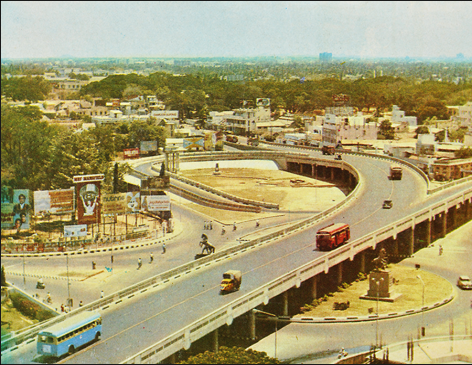
Behold the magnificent Anna Flyover in Chennai!
Image
  Anna Flyover Mount Road Chennai, 1973 Postcard   Source: https://www.past-india.com/photos-items/gemini-flyover-mount-road-chennai-1973-postcard/   Anna Flyover was built by the East Coast Constructions and Industries Company. Petra Oil takes immense pride in its lineage as a descendant of ECCI Company. Our connection traces back to the remarkable Anna Flyover in Chennai, a testament to ECCI's expertise and ingenuity. July 1 st marks the 50 th anniversary of the landmark of the city Chennai “The Anna flyover” otherwise known as Gemini flyover which was built in the year 1973 stretching from Gemini Circle going all the way up to the Island grounds near Central Station. Though it is just 1500 feet long and 48 feet wide, it is South India’s first flyover and India’s third flyover.  Mr Abdur Rahman, the founder and CEO of East Coast Constructions Mr Abdur Rahman, the founder and CEO of East Coast Constructions and Industries, paved the way for us to thriv...

5 Types Of Road Construction For a Durable and Cost-Effective Solution

Image
  Introduction: Road construction is a critical aspect of infrastructure development, facilitating easy transportation of goods and people across different locations. Constructing a road requires significant investment in terms of finances, time, and manpower. Therefore, choosing the right type of road construction is essential to ensure durability and cost-effectiveness. In this blog post, we will discuss the five types of road construction that provide a durable and cost-effective solution. Asphalt concrete pavement Asphalt concrete pavement is the most common type of road construction, and it is popular because of its durability and resistance to weather elements. It is composed of a mixture of asphalt and aggregate, and the materials are heated and mixed to produce a smooth surface. Asphalt concrete pavement is suitable for high-traffic areas and lasts up to 20 years. Concrete pavement Concrete pavement is another popular road construction method that provides durability and st...

WHY IS BITUMEN WATERPROOF

Image
  Bitumen is a unique material that is commonly used in the construction industry for various applications, including waterproofing. It is a viscous, black, and sticky substance that is made from crude oil. Bitumen is a popular waterproofing material because of its exceptional waterproofing properties. In this blog post, we will explore the reasons why bitumen is waterproof and why it is an excellent choice for waterproofing. Firstly, bitumen is waterproof because it is a hydrophobic material. This means that it repels water and prevents it from penetrating through it. Bitumen is a complex mixture of hydrocarbons, and its molecular structure makes it impermeable to water molecules. When bitumen is applied to a surface, it creates a continuous, seamless layer that blocks water from passing through. Secondly, bitumen is waterproof because it is a durable material. Bitumen is a highly viscous material that can withstand extreme temperatures and weather conditions. It has excellent ...

IS BITUMEN FLAMMABLE?

Image
  Bitumenis a commonly used construction material for road paving and roofing. It is derived from crude oil and is a thick, black, and sticky substance. The question that often arises is whether bitumen is flammable or not. In this article, we will explore the flammability of bitumen and provide you with a table summarizing its flammability properties. Is Bitumen Flammable? The short answer is yes, bitumen is flammable. It can ignite if it comes into contact with an ignition source, such as a spark or flame. The flammability of bitumen is due to the presence of hydrocarbons, which are highly combustible substances. The level of flammability depends on the type and grade of bitumen. The flashpoint of bitumen is the temperature at which it releases enough flammable vapors to ignite in the presence of an ignition source. The flashpoint of bitumen varies between 200°C and 300°C, which is higher than the flashpoint of gasoline. This means that bitumen is less likely to ignite than gaso...

When was the bitumen road invented?

Image
  Bitumen roads have been used for thousands of years, with evidence of bitumen being used as a binding material for roads and buildings dating back to ancient civilizations such as the Babylonians and Egyptians. However, the modern development of bitumen roads as we know them today began in the early 19th century. The first modern asphalt road was built in 1824 in Paris, France, using a mixture of natural asphalt and gravel. The technique spread to other parts of Europe and North America in the following decades, and by the late 19th century, asphalt had become the dominant material for road surfaces. The invention of the automobile in the late 19th century led to further improvements in bitumen road construction, as roads needed to withstand heavier traffic and higher speeds of motor vehicles. Today, bitumen is still one of the most commonly used materials for road construction worldwide.

WHAT IS THE PROCESS OF BITUMEN EMULSION?

Image
  Bitumen emulsion is a versatile and eco-friendly alternative to traditional hot bitumen for road construction, surface sealing, and waterproofing applications. It has several advantages, including lower energy consumption, reduced emissions, and improved safety. It is a mixture of bitumen and water, stabilized by an emulsifying agent. The process of making bitumen emulsion involves the following steps: Preparation of bitumen: Bitumen is first heated to a temperature of around 160-180°C to reduce its viscosity and make it easier to mix. Preparation of water: Clean water is added to a tank and heated to a temperature of around 50-60°C. Emulsifying agent: A small amount of emulsifying agent, such as soap or detergent, is added to the water and mixed thoroughly. The emulsifying agent helps to stabilize the bitumen and water mixture. Mixing: The heated bitumen is slowly added to the emulsifying agent solution, while stirring continuously. The mixture is homogenized using a high-speed...

How bitumen is produced from crude oil?

Image
  Bitumen is a highly viscous and dense form of petroleum that is produced from crude oil. It is typically found in natural deposits or obtained as a by-product of the refining process. The production of bitumen from crude oil involves several steps, which are as follows: Extraction: The first step in the production of bitumen is the extraction of crude oil from the ground. This is typically done using drilling rigs and other equipment, and the crude oil is usually extracted from deep underground reservoirs. Separation: Once the crude oil is extracted, it is transported to a refinery where it is processed to separate the different components. This involves heating the crude oil and passing it through a series of distillation columns, where the lighter components are separated from the heavier ones. Upgrading: After separation, the heavy components of the crude oil, including bitumen, are further processed through a process called upgrading. This involves breaking down the heavy...